Does Journaling Help With Overthinking or Make It Worse?
It’s 3 a.m., the room is silent, and yet, your mind is deafening. You’re replaying a conversation from three days ago, wondering if your tone was too much. Then your mind jumps to next week’s deadline and picture every way you could fail to meet it. You reach for your notebook, and you stop. Does journaling help with overthinking? Or does writing these thoughts down only make it worse?
Through years of journaling and leading writing circles, I know the mind follows the body. The body feels what's right and true first. The tightness in your chest is a signal, and the page is where you can learn to understand it. The key is to write so the page settles you rather than send you into a spiral.
Why “Getting It All Out” Can Backfire
We’re told to get it all out, and for many women, venting leaves them feeling worse than when they started. Writing about a painful moment with no grounding can pull you back into it. Your nervous system interprets the retelling as the danger happening right now.
A writing practice that's healing teaches you the difference between reliving and releasing. If you step away from your journal feeling more overwhelmed than when you opened it, you didn't set the pain down. You ventured back into it. Safety in the body comes first, and it's how we gain insight.
Writing Slows the Mind to the Speed of Your Hand
Overthinking feeds on speed so it's easy to get stuck ruminating when your thoughts stay in your head. Your hand's slow movement pulls you out of the loop and allows you to be more conscious of what you're thinking.
“You feel the way you think.” (David D. Burns, MD)
Slowing your thoughts down is like medicine. The thought moves out of your head and onto the page, and your body can finally settle.
Name the Thought Instead of Becoming It
When you're worrying, you can't see that it's a thought about what might happen. You believe it as fact. When you write, you can create distance from the thought. Write what you're thinking, and then name what your mind is doing.
“I should have handled that meeting in a different way.” [regret]
“I have to get this right or I'll lose my credibility." [worst-case story]
“I always mess things up when it matters most.” [old story]
By naming the pattern, you remember that a thought is mental weather moving through. You become the observer of it instead of feeling trapped by it.
Notice What Feels Good, Not Only What Hurts
Most of us open a journal to fix what's wrong, to get out all the bad. Dwelling on what’s right matters too. When things are going well, make a note of it, and revel in it for a moment that feels longer than necessary.
Develop the habit of tracking what feels good in your body the same way you track what's hard. Make a note of the relaxing of your shoulders, the deep breathing, how the sun feels on your skin. Your mind notices threat by design, so noticing what’s good is a purposeful practice to build. It also creates self-trust.
How to Journal Without Ruminating: Return to Your Values
Journaling becomes rumination when you get lost in the suffering. It creates clarity when it moves you toward peace. This shift happens when you stop wondering “why is this happening to me” and ask better questions.
Try these when you catch yourself back on the same worry for the tenth time:
Would I see this the same way if I felt rested?
Am I being as kind as I want to be?
Will this matter in five years?
These kinds of questions give you back your own agency. They help you to find alignment instead of sinking further into your story.
Give the Day’s Worries a Destination Before Bed
Bedtime is when we can become prone to overthinking. All the distractions fall away, and we replay every problem. Journaling before bed gives those thoughts a place to go so you can fall sleep.
Research found that writing your to-do list for tomorrow before bed can help you fall asleep faster. According to research, it's more effective than revisiting what already happened. Releasing tomorrow's worries onto the page signals to your body that it's safe to rest. If you close the entry with one thing you’re grateful for, the last image your mind holds is positive.
The Five-Minute Practice That Builds Trust
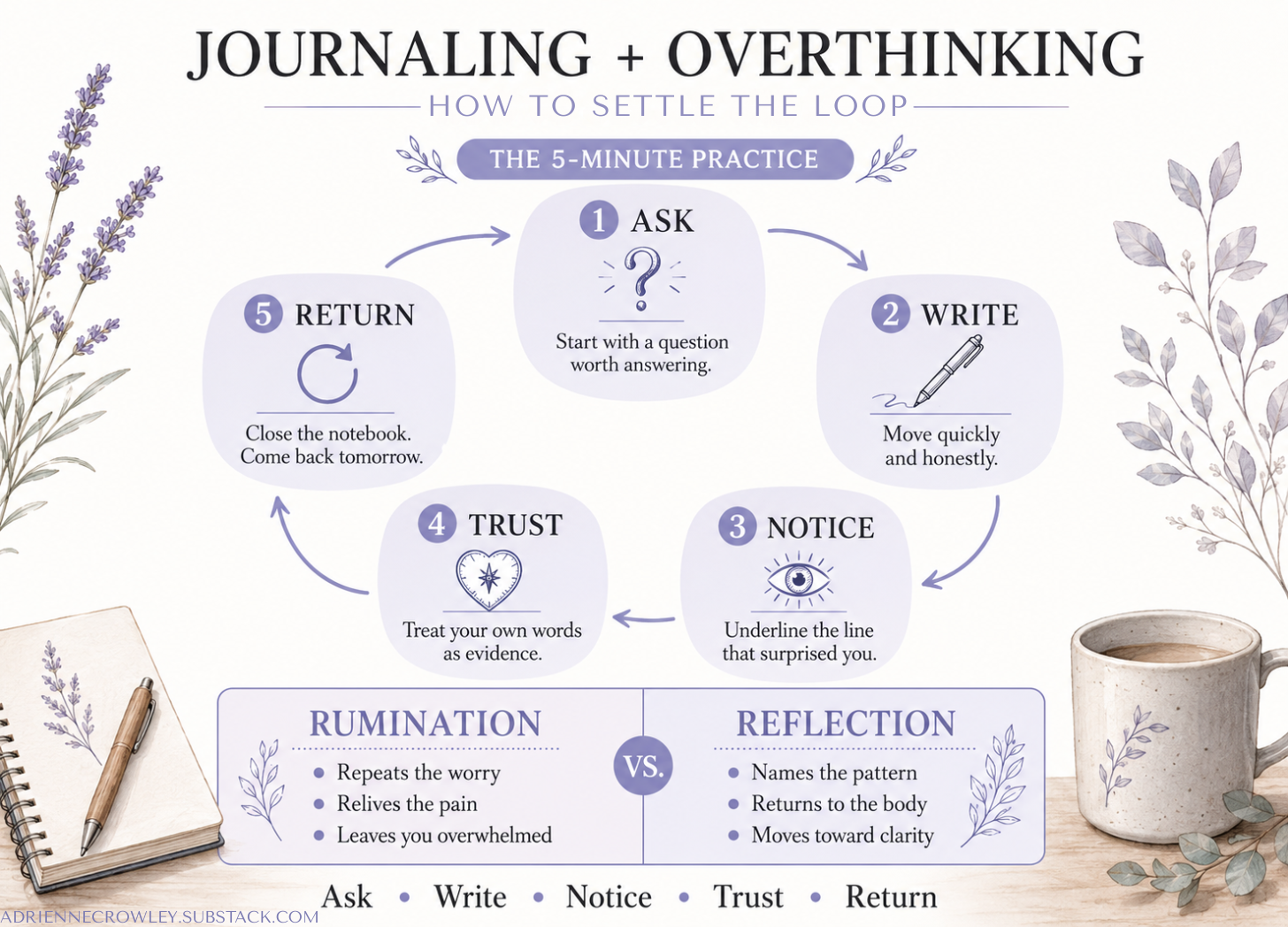
This is the daily practice I teach inside the Writing Wild Society. It takes five minutes, though you can always write longer.
Ask: Start with a question worth answering. The daily prompt inside the community provides this.
Write: Move your pen across the page, letting the words spill out. Don't stop to tidy your thoughts.
Notice: Reread what you wrote, and underline anything that surprised you or that you felt in your body. This is usually your intuition speaking to you.
Trust: Your words are data about what you know.
Return: Close the journal, and come back to the page tomorrow with a new question to explore.
Practice this often, and you'll discover that your body knows more than your thinking mind.
If you want to journal with other women, check out the Writing Wild Society. Here, we write to hear ourselves and learn to trust what we know.
If you want to journal alongside other women, check out the Writing Wild Society, where we write to hear ourselves clearly and learn to trust what we know.
Frequently Asked Questions
-
It can when it's only a venting session. You'll feel more stress when you write the same distressing thought over and over. Some structure and a body check-in will help you write through the stress and anxiety.
-
Slow down, name the thought and the pattern. Or start with noticing what you feel in your body and explore that before you write to make sense of the situation.
-
Yes, it helps when it’s structured rather than a rumination session. Research on expressive writing shows a meaningful decrease in anxiety with consistent practice. Writing interrupts overthinking and helps you work through it.
You Already Know the Way
Your overthinking makes sense, and it's something we all do. It’s a sign that your mind is trying to keep you safe. Your body knows the way back to peace, and writing is how you hear the signals.
What are you noticing in your body as you read this?
If you’re ready to keep writing alongside other women, I’d love to welcome you into Writing Wild Society. This is where we write to connect with ourselves and learn to trust what we know.